The main ingredient in cigarettes is tobacco. Tobacco is a green, leafy plant that is grown in warm climates. Farmers use many chemicals to grow tobacco. They use fertilizers to make the soil rich and insecticides to kill the insects that eat the tobacco plant. After the tobacco plants are picked, they are dried, and machines break up the leaves into small pieces. Artificial flavorings and other chemicals are added. Some chemicals are put in cigarettes to keep them burning; otherwise, they would go out.
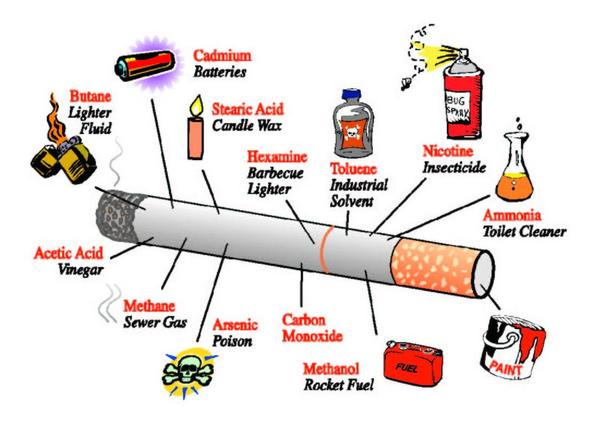
There are approximately 600 ingredients in cigarettes. When burned, they create more than 7,000 chemicals. At least 69 of these chemicals are known to cause cancer, and many are poisonous. Many of these chemicals also are found in consumer products, but these products have warning labels. While the public is warned about the danger of the poisons in these products, there is no such warning for the toxins in tobacco smoke.
“One of the issues with cigarettes is that they have hundreds of added ingredients, not just what is naturally in the tobacco plant,” environmental health scientist with Mount Sinai School of Medicine, Dr. Luz Claudio told to Medical Daily. “What complicates this even more is that when these chemicals burn, they form other chemicals that may have additional effects on health.”
While tobacco companies like R.J. Reynolds insist that a lot of the ingredients found in cigarettes are also found in Food and Drug Administration-approved foods and beverages, a few of these ingredients are also found in products that you would never think to put in your body otherwise. Take for example arsenic, an inorganic substance found in wood preservatives and rat poison.
On the FDA’s Established List of Harmful and Potentially Harmful Constituents in Tobacco Products and Tobacco Smoke, arsenic’s dangers include: carcinogen, cardiovascular toxicant, and reproductive or developmental toxicant.
We’ve listed information on a few compounds found in tobacco and cigarette smoke. Note that the most widely known and most abundant chemicals are nicotine, tar, and carbon monoxide are at the bottom of this list:
[bullet_block style=”size-16″ small_icon=”23.png” width=”” alignment=”center”]
- Acetaldehyde – this chemical is used in resins and glues. It is believed to be a carcinogen. Experts say it is likely that it facilitates the absorption of other dangerous chemical into the bronchial tubes.
- Acetone – this chemical is used in solvents. Found in nail polish remover. It irritates the eyes, nose and throat. Long-term exposure can damage the liver and kidneys.
- Acetic Acid – an ingredient in hair dye
- Acrolein – commonly used in herbicides and polyester resins. It is also used in chemical warfare. Acrolein is an ingredient in tear gas. It is very poisonous and irritates the eyes and upper respiratory tract.
- Acrylonitrile – also known as vynil cyanide. Experts believe it is a human carcinogen. It is used in synthetic resins, rubber and plastics.
- 1-aminonaphthalene – in ingredient in weed killers. It is a known carcinogen.
- 2-aminonaphthalene – this substance causes bladder cancer. It is banned in industrial uses.
- Ammonia – it is known to cause asthma and raise blood pressure. Ammonia is used in cleaners.
- Arsenic – used in rat poison
- Benzene – used in gasoline, found in rubber cement, causes several cancers, including leukemia
- Benzo[a]pyrene – this chemical is found in coal tar pitch, and creosote. It is a known carcinogen, especially for lung and skin cancers. It can also undermine human fertility.
- 1,3-Butadiene – it is used in latex, rubber and neoprene products. Experts believe it is most likely a carcinogen.
- Butane – used in lighter fluid
- Butyraldehyde – this chemical affects the lining of the lungs and nose. It is used in solvents and resins. It is a powerful inhalation irritant.
- Cadmium – a known carcinogen. It damages the brain, kidneys and liver. Cadmium is used in non-corrosive metal coatings, storage batteries, pigments, and bearings.
- Catechol – it elevates blood pressure and irritates the upper respiratory tract. It can also cause dermatitis. Catechol is used as an antioxidant in oils, inks and dyes.
- Chromium – known to cause lung cancer. It is used in wood treatment, wood preservatives, metal plating and alloys. Those involved in welding have the greatest risk of exposure.
- Cresol – acute inhalation can cause throat, nasal and upper respiratory irritation. It is used in disinfectants, wood preservatives and solvents.
- Crotonaldehyde – a warning agent in fuel gasses. Experts say it messes up the human immune system. It can also cause chromosomal changes.
- Formaldehyde – embalming fluid, part of the resin used in foam insulation, plywood, fiberboard and particleboard. It can cause nasal cancer, as well as damaging the digestive system, skin and lungs.
- Hexamine – found in barbecue lighter fluid
- Hydrogen Cyanide – some states use this chemical in their gas chambers for executions. It weakens the lungs and causes fatigue, headaches and nausea. It is used in the production of acrylic plastics and resins, and can also be a fumigant.
- Hydroquinone – has a detrimental effect on the central nervous system. Also causes eye injuries and skin irritation. It is used in varnishes, motor fuels and paints.
- Isoprene – similar to 1,3-butadiene. It causes skin, eye and mucous membrane irritation. It is used in rubber.
- Lead – lead damages the nerves in the brain, as well as the kidneys and the human reproductive system. Lead intake can also cause stomach problems and anemia. It is a known carcinogen and is particularly toxin to children. Lead is used in paint and metal alloys, used in batteries.
- Methyl Ethyl Ketone (MEK) – depresses the human nervous system, irritates the eyes, nose and throat. MEK is used in solvents.
- Methanol – a main component in rocket fuel
- Naphthalene – an ingredient in mothballs
- Nickel – a known carcinogen, nickel also causes bronchial asthma and upper respiratory irritation.
- Nitric Oxide – this is a major contributor to smog and acid rain. It is made by gasoline combustion. Scientists say it is linked to a higher risk of developing Alzheimer’s disease, Parkinson’s disease, Huntington’s disease and asthma.
- NNN, NNK, and NAT – NNN and NNK are known carcinogens and NAT might be one. The three compounds are unique to tobacco. NNN may also cause reproductive problems. NNK is closely linked to lung cancer risk.
- Phenol – this highly toxic substance is harmful for the CNS (central nervous system), cardiovascular system, respiratory system, the kidneys and liver. It is used in resins in plywood and construction materials.
- Propionaldehyde – irritates the respiratory system, skin and eyes. It is used as a disinfectant.
- Pyridine – irritates the eyes and upper respiratory tract. It also causes nervousness, headaches and nausea. Experts say it might cause liver damage. This substance is used in solvents.
- Quinoline – it is used for stopping corrosion and also as a solvent for resins. It is a severe eye irritant, is harmful to the liver, and causes genetic mutations. Experts believe it may be a carcinogen.
- Resorcinol – irritates the eyes and skin. It is used in resins, adhesives (glue) and laminates.
- Styrene – irritates the eyes, may slow down reflexes, and causes headaches. It is linked to a higher risk of leukemia. This substance is used in fiberglass, pipes, plastic and insulation materials.
- Toluene – causes confusion, memory loss, nausea, weakness, anorexia, and drunken movements. It is also associated with permanent brain damage. The chemical is used in resins, oils and solvents.
- Nicotine – an extremely fast-acting drug. It reaches the brain within 15 seconds of being inhaled. Exposure to sufficient amounts can lead to vomiting, seizures, depression of the CNS (central nervous system), and growth retardation. It can also undermine a fetus’ proper development.
[/bullet_block]
Nicotine is not carcinogenic. However, it is highly addictive. Smokers find it very hard to quit because they are hooked on the nicotine. Research suggests that nicotine is as addictive as heroin, cocaine, or alcohol. That’s one of the reasons it’s so hard to quit. Withdrawal from nicotine can mean irritability, craving, depression, anxiety, cognitive and attention deficits, sleep disturbances, and increased appetite.
If cigarettes and other tobacco products had no nicotine, the number of people who smoke every day would drop drastically. Without nicotine, the tobacco industry would collapse. Nicotine is a strong poisonous drug. It is the main ingredient in insecticides or bug sprays. In its pure form, just one drop on a person’s tongue would kill him/her.
[bullet_block style=”size-16″ small_icon=”23.png” width=”” alignment=”center”]
- Carbon Monoxide – this is a poisonous gas. It has no smell or taste. The body finds it hard to differentiate carbon monoxide from oxygen and absorbs it into the bloodstream. Faulty boilers emit dangerous carbon monoxide, as to car exhausts. If there is enough carbon monoxide around you and you inhale it, you can go into a coma and die.
[/bullet_block]
Carbon monoxide decreases muscle and heart function, it causes fatigue, weakness, and dizziness. It is especially toxic for babies still in the womb, infants and individuals with heart or lung disease.
A smoker inhales this gas which is also found in the exhaust of a car. This gas interferes with our respiratory (breathing) and circulatory (heart, arteries, and veins) systems. When we breathe in air through our nose and mouth, the air passes down the windpipe (trachea) and bronchial tubes into the lungs. The cilia which are made up of small hairs and mucous (a sticky fluid also found in the nose) help to clean this air as it moves down and into the lungs. The cilia remove small pieces of dirt, dust, and germs.
In a healthy nonsmoker, the lungs are made up of soft, spongy, pinkish-gray tissue. The lungs also have hundreds of air sacs that fill with air when we inhale or breathe in. They are elastic like rubber bands.

One of the jobs of the lungs is to take oxygen in from the air. This oxygen is carried in the blood to the heart. The heart pumps the oxygen rich blood throughout the body by arteries. Arteries are large tubes with thick, strong walls. Oxygen is used by all cells of the body to do their work.
The lungs also must get rid of carbon dioxide which is the waste product of the cells’ work. When we exhale, breathe out, we are getting rid of the carbon dioxide from the body.
When a person smokes cigarettes, the carbon monoxide in the smoke gets into his/her blood stream. This reduces the amount of oxygen going to the heart. In addition, the chemicals in cigarette smoke narrow the walls of the arteries. With less oxygen passing through the arteries, the heart must work harder. Blood pressure also goes up.
[bullet_block style=”size-16″ small_icon=”23.png” width=”” alignment=”center”]
- Tar – consists of several cancer-causing chemicals. Tar is the oily material which remains after tobacco passes through the filter. When a smoker inhales cigarette smoke, 70% of the tar remains in the lungs. Try the handkerchief test. Fill the mouth with smoke, don’t inhale, and blow the smoke through the handkerchief. There will be a sticky, brown stain on the cloth. Do this again, but this time inhale and the blow the smoke through the cloth, there will only be a very faint light brown stain.
[/bullet_block]
Radioactive Chemical Found in Fertilizers Leads to Lung Cancer
Did you know that your body also accumulates harmful radioactive chemicals from cigarettes? These dangerous elements come from the pesticides used on tobacco fields.
While it is true that smoking cigarettes can cause cancer, there is a more specific substance that is the root cause of cancer among smokers. Tobacco fields typically use calcium phosphate fertilizers, which contain polonium-210. When polonium-210 decays, it releases alpha particles that can damage human cells they come into contact with.
Research suggests that main lung damage comes from the radiation emitted by these fertilizers. It also showed that polonium, specifically, causes cancer in laboratory animal. Moreover, according to a study in 2009 the radiation that you get from smoking 1 ½ cigarette packs is tantamount to 300 chest x-ray films per year.
A 2011 report from Nicotine and Tobacco Research also revealed there are internal documents stating that the tobacco industry have recognized the danger brought by these radioactive chemicals. According to these papers, acid wash was found to be an effective solution in removing polonium-210 from the tobacco leaves, but the industry avoided using it as it would lessen the pleasurable effect of nicotine to smokers.
According to the American Cancer Society, cigarette smoke accounts for at least 30 percent of all cancer-related deaths in the U.S. This includes 87 percent of lung cancer deaths among men and 70 percent of among women. Cigarette smoke can also lead to certain lung diseases including emphysema, bronchitis, and chronic airway obstruction.
There are currently more than 16 million Americans suffering from a disease that was caused by smoking. If appropriate prevention strategies are not put in place to curb the number of young Americans who pick up smoking, an estimated 5.4 million people under the age of 18 will die prematurely due to a smoking-related illness.
The tobacco industry will certainly not be your number one motivator in stopping you from smoking, even if they know that this may lead to your death. It is now your decision to throw away your smoking habit for good and choose a healthier lifestyle, which can add more years to your life.
See also What Are the Side Effects of Smoking Cigarettes?
[divider style=”10″]
References:
National Heart, Lung, and Blood Institute, How Does Smoking Affect the Heart and Blood Vessels
American Heart Association, How Cigarettes Damage Your Body
Nordqvist, Christian. “What Chemicals Are In Cigarette Smoke?.” Medical News Today. MediLexicon, Intl., 13 Jul. 2015. Web. 28 Nov. 2016. http://www.medicalnewstoday.com/articles/215420.php
Nordqvist, C. (2015, July 13). “What Chemicals Are In Cigarette Smoke?.” Medical News Today. Retrieved from
http://www.medicalnewstoday.com/articles/215420.php
https://www.atsdr.cdc.gov/substances/toxsubstance.asp?toxid=3
http://www.fda.gov/TobaccoProducts/GuidanceComplianceRegulatoryInformation/ucm297786.htm
ACSA.net, Radioactive Polonium in Food and Water
ACSA.net, Radioactive Polonium Found in Tobacco
Int J Environ Res Public Health. 2009 February; 6(2): 558-567
Nicotine and Tobacco Research, September 27, 2011