
Your skin is as unique as you are, and its needs can vary based on factors like genetics, environment, and lifestyle. Healthy skin doesn’t happen overnight. A consistent skin care routine is essential to optimize your skin’s health, fortify its defenses and maximize your results.
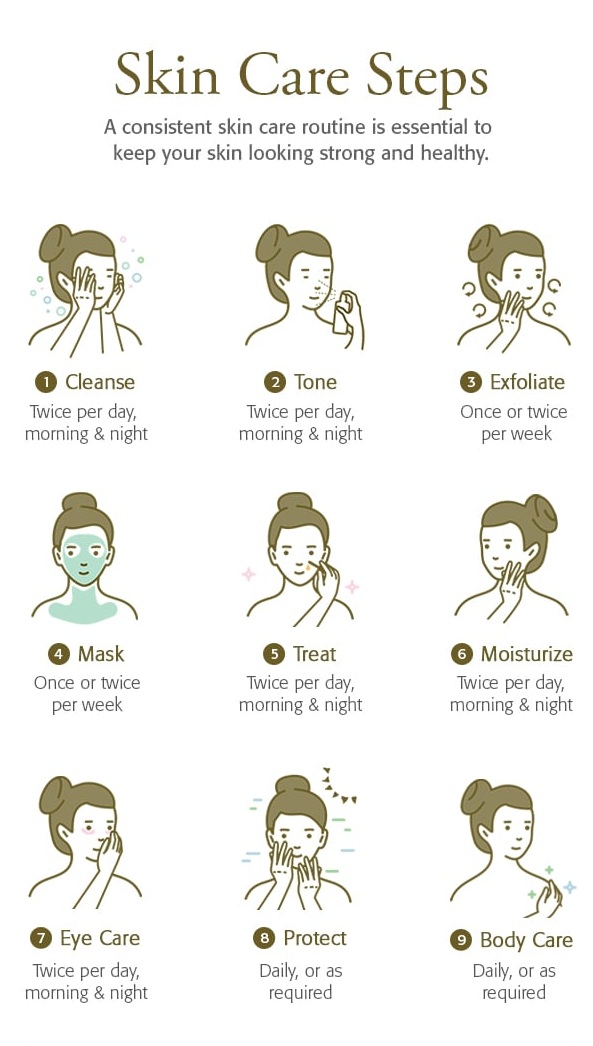
To enhance your knowledge, we’ve compiled the 9 essential steps for a skin care routine for achieving or maintaining healthy, glowing complexion.
Apply your skin care products in the following order for optimal results:
- Cleanse
- Tone: Essence, Facial Mist or Toner
- Exfoliate
- Mask
- Treat: Serum, Concentrate or Facial Oil
- Moisturize
- Eye Care
- Protect/SPF
- Body Care
Cleanse
Twice per day, morning and night.
An effective beauty routine starts with a smooth, deeply cleansed dermis. Before you try to reap the full benefits from your skincare products, focus on removing the impurities – from makeup to dirt and oil – from your skin without stripping its precious barrier.
Washing your face once with a conventional cleanser is unlikely to remove all the makeup and/or sunscreen on your skin. Thoroughly removing makeup with an effective cleanser is incredibly important for avoiding breakouts and lessening signs of aging. Makeup residue that’s left on overnight can cause skin fatigue, clogged pores, and other skin concerns. We recommend removing your makeup thoroughly before cleansing your skin.
Start with washing your face well with a hydrating cleanser that can sweep away dirt and oil, while adding hydration to any dry patches. A thorough cleanse clears your skin of oil and debris that can lead to clogged pores and dullness. It also prepares your complexion for further treatment, making it easier for your skin to absorb the beneficial ingredients in the rest of your routine. Whether you choose an oil, balm, gel or cream cleanser will depend on your skin type and the concerns you hope to address.
Tone: Essence, Facial Mist or Toner
Twice per day, morning and night.
Why? Using a toner comes next to clear leftover debris (including loosened dirt, oils, and dead skin cells) from cleansing. Toning completes the cleansing process by conditioning your skin and adding beneficial vitamins and minerals to your complexion. It also preps the skin for the following power players in your skincare routine.
How it Helps: Toning your skin after cleansing deeply hydrates and balances skin pH levels, resulting in a soothed, refreshed complexion. Unlike alcohol-based toners of the past, today’s toners, essences and facial mists support the effectiveness of your cleanser by adding replenishing ingredients that support your skin’s health. Cleansing and toning work together like shampoo and conditioner: Both steps help keep the skin as healthy as possible. For rehydration and deep-sweep cleansing, you don’t want to miss out on this essential prep step that will elevate your entire beginner’s skincare game.
Exfoliate
Once or twice per week.
Exfoliating is essential to encourage healthy skin cell turnover, eliminate buildup and relieve pore congestion. Dry skin can become clogged with dead skin cells trapping skin-produced oil inside the pores. To avoid blackheads and breakouts, exfoliate no less than once a week. This allows moisture to properly penetrate the skin without clogging or uselessly laying over the top while eliminating flakiness.
- Minimize Blemished Skin and Breakouts
- Improve Skin Hydration and Moisture Levels
- Challenge Your Skin’s Ageing Process
- Stimulate Blood Flow
- Prepare Your Skin for Tanning (real or fake!)
Exfoliants comprise gentle chemical, enzymatic and physical varieties for home care, as well as more potent peels and treatments.
When exfoliating, it’s important to be gentle on your skin. Being too harsh can be drying and could lead to microtears Exfoliating scrubs and creams are best used on damp skin so lather up and exfoliate your skin during your morning shower or night-time bath.
Whether you’re using an exfoliating scrub or an exfoliating body puff or brush, make small, circular motions over the area you want to exfoliate. Exfoliate each area for 20-30 seconds then rinse off with warm water. After exfoliating, apply a nourishing body moisturiser to help keep your skin glowing.
Mask
Once or twice per week. An additional treatment to indulge in is a face mask. Face masks contain high amounts of concentrated vitamins and nutrient-rich ingredients which absorb efficiently into the skin, making it appear healthy and resilient. In addition to their hydrating and firming benefits, masks can be used to control more persistent skin concerns like acne, large pores and dark spots. If you’re applying a mask, it will depend on the mask’s instructions, but it should also be applied onto cleansed skin. If the mask is supposed to be rinsed off (like an exfoliating, firming or detoxifying mask), apply it right after cleansing. If the mask is supposed to be left on overnight, apply it right before your moisturizer. You can also “multi-mask” to target different areas—like applying a charcoal-based mask to an oily T-zone, versus a hydrating mask to your cheeks, forehead, and neck.
Spot treatments should be used as needed, generally as the last step in your evening routine. If you want to apply a pimple patch, you may want to blot the spot with a clean tissue so the patch is able to stick.
Treat: Serum, Concentrate or Facial Oil
Twice per day, morning and night. Your daily routine should include a serum, concentrate or facial oil. These potent formulas contain concentrated amounts of active ingredients to target concerns and neutralize the effects of environmental stressors.
Facial serums, those lightweight powerhouses in skincare, pack a punch with their high concentration of active ingredients. Unlike traditional moisturizers, serums penetrate deeper into the skin, addressing specific concerns with targeted precision. Whether combating signs of aging, boosting hydration, or enhancing brightness, serums are tailored solutions for diverse skincare needs.
Unlike serums, which have a gel-like consistency, concentrates are lightweight lotions with both absorbent and protective qualities. As the name suggests, a concentrate is a highly concentrated formula of active ingredients – higher percentages of active ingredients target specific concerns faster. Similar to a serum which is a light-weight, quick-absorbing booster treatment, but unlike a serum in the fact that a concentrate is more of a light-weight consistency. It will still absorb quickly, but provides a more nourishing effect in addition. A concentrate’s purpose is to actively target delicate or common areas that show signs of aging faster, such as the eye contours, above the lip, marionette lines, neck and décolleté. They can be layered with serums and moisturizers, or simply used on their own.
Oils These ultra-luxe elixirs provide anti-inflammatory and antibacterial benefits, which can help reduce the redness and sensitivity of acne while diminishing post-breakout discoloration. Facial oils also provide an extra sealant of protection, and can transform skin from dull to dazzling. If skin is deprived of natural oils, it will go into overproduction mode to make up for a lack of oil or sebum. Drying out oily skin by skipping moisturization like facial oils provide and using harsh, stripping ingredients will actually lead to breakouts, acne, and even more oil.
If you’re using the correct oil for your skin, it can help replenish your natural facial oils, which can keep levels balanced and breakouts at bay. Some facial oils can even target excess oil, and help to slough away dead skin cells that might clog pores, which could lead to acne.
The serum, concentrate or oil you choose will depend on the particular concerns and conditions you hope to prevent or correct.
Eye Care
Twice per day, morning and night. The skin around the eyes can show the earliest signs of aging, especially if not taken care of properly. This is because the skin around the eyes is thinner and more fragile than other parts of the body. Besides, the eyes have to work continuously every day, such as blinking or expressing emotions, thus causing premature signs of aging.
Ultraviolet (UV) rays are external agents that greatly affect the skin of the eyes and body, causing the aging process to take place faster. However, no matter how old you are, taking care of your eyes and body is essential to prevent premature aging.
According to research by dermatologists, “Eye cream is one of those things that people often don’t use. However, you need a cream that can penetrate this area to provide the necessary moisture to the skin.” Do not rely on facial moisturizer: Many patients often wonder if they can use regular eye moisturizer, most of the answer is no. You need an eye cream specifically designed for this area. Facial serums and moisturizers may contain active ingredients, such as retinoids, that are too strong for the skin under the eyes.
Choose the right eye cream: Just because an area of skin is thin doesn’t mean you just need to use a bland moisturizer. One of the best ones to look for is an eye cream that contains retinol (a derivative of vitamin A). An eye cream that contains retinol will be different from a regular face cream. Due to the risk of irritation, it will be formulated with a lower concentration of retinol and emollients to increase hydration, reducing the risk of irritation.
Some areas require a lighter touch. The skin around your eye area is seven times thinner than the rest of your face and needs to be treated with special care. Regular eye cream application not only maintains the health, thickness and elasticity of this delicate area, it also reduces the look of fine lines, wrinkles, dark circles and puffiness.
Moisturize
Twice per day, morning and night.
Why? Used daily, moisturizers keep skin soft, supple and protected. Moisturizing not only targets and treats specific issues in the top layers of the skin, it also provides necessary support for the skin’s natural lipid barrier. A strong and healthy barrier enables the skin to better retain moisture and repel external irritants. Remember, even oily skin needs moisture and hydration!
There’s a reason moisturizers are the most-bought skincare product. They hydrate and balance skin – and all skin types need moisture! Not only does the natural moisture in your skin start evaporating as you age, certain skin types will also endure skin hardships without moisture. Dry skin needs moisturization to hydrate and maintain skin’s optimal pH, while oily skin types will overcompensate with even more oil if there’s no moisturizer in place. Using a natural moisturizer will keep your complexion healthy, happy, and radiant.
Picking the right natural moisturizer is the key to getting the desired result. Your skin will only look fresh and alive when the moisturizer will provide what it needs. For oily skin without moisture, your dermis will lose its balance and start producing more oil, which could lead to clogged pores and acne. Dry skin types, on the other hand, may experience extra dryness, dehydration, and even irritation without proper moisture. A lack of moisturization for dry skin may exasperate fine lines and wrinkles.
Protect/SPF
Daily, or as required.
Like a double-edged circle, the sun provides many advantages – say, life on Earth wouldn’t exist, for starters. But unfortunately, it has its health and skin disadvantages for us planet dwellers who don’t regularly wear adequate sun protection.
To keep your skin looking healthy and young, it’s important to protect it from the sun’s harmful rays – and from harm from conventional sunscreen formulas! Sunscreen is meant to protect your skin from the sun’s harmful rays, and it’s hard to emphasize how important this one product is for your delicate dermis.
Sunscreen specifically shields your skin from the ultraviolet (UV) rays, which consist of UVA rays that are most associated with long-term aging of the skin, and UVB (burning) rays, which are attributed to sunburn. UVA light penetrates all levels of the skin, from the epidermis down to the dermis. This damaging light can affect the collagen and elastin fibers that keep your skin smooth and plump.
If UVB light reaches the epidermis; it can cause photoaging, damage DNA, and trigger the formation of precancerous cells as well as excess melanin production. Melanin is a pigment that’s meant to protect the skin from the sun’s rays, but it results in the appearance of dark spots, popped blood vessels in the skin, sunburns, premature aging, and an increased risk of skin cancer.
Thus the final and most crucial step in every skin care routine is sun protection. Year-round, apply a broad spectrum sunscreen or SPF moisturizer to shield your skin from exposure.
And just like not all ice cream is made equal, not all SPF is created equal – or even healthy! Thankfully, there’s been an upshift towards natural alternatives, driven by concerns about the potential health risks and the environmental impact of chemically laden sunscreens. This shift signifies a growing awareness of the need to protect our skin and the planet simultaneously.
Body Care
Daily, or as required.
Skin care doesn’t end at your décolleté. The rest of your body can also display areas of discomfort depending on your skin type and skin concerns. Extend your skin care routine by applying nutrient-rich body products that keep your skin looking strong and youthful from head-to-toe.
By following this basic skin care routine, taking care of your skin from the inside out, and protecting it from external factors, you can gradually improve the overall health and appearance of your skin. Remember to listen to your skin’s needs and make adjustments to your routine as necessary. With time and patience, you can achieve the radiant skin you desire.