
The Golden Ratio, often referred to as the “divine proportion,” has fascinated mathematicians, artists, architects, and nature enthusiasts for centuries. This seemingly simple numerical relationship appears mysteriously in everything from the spirals of galaxies to the layout of ancient temples. But what exactly is the Golden Ratio, and why does it hold such significance across diverse fields?
A Brief History of the Golden Ratio
The Golden Ratio has a rich history dating back thousands of years. The earliest known mention of the Golden Ratio is found in Euclid’s “Elements,” a mathematical treatise written around 300 BCE. Euclid described the division of a line into two unequal parts such that the ratio of the whole line to the longer segment is equal to the ratio of the longer segment to the shorter one. This description laid the foundation for what would later be called the Golden Ratio.
Other early mathematicians like Pythagoras recognized the proportion, but they didn’t call it the golden ratio. It wasn’t until much later that the proportion would take on its mystique. In 1509, Italian mathematician Luca Pacioli published the book De divina proportione, which, alongside illustrations by Leonardo da Vinci, praised the ratio as representing divinely inspired simplicity and orderliness.
Because of Pacioli’s book and Leonardo’s illustrations, the golden ratio gained fame among mathematicians and artists. In the centuries since Pacioli’s book, many enthusiasts have claimed that the number is naturally pleasing to the eye, that it is a mathematical distillation of beauty, and that golden ratio line segments, golden rectangle side lengths, and golden triangles are represented throughout art history.
During the Renaissance, the Golden Ratio was rediscovered and celebrated by artists and architects. The Italian polymath Leonardo da Vinci, among others, believed that this proportion represented an ideal form of beauty and harmony. Da Vinci used the Golden Ratio in his famous drawing “Vitruvian Man,” which depicts the ideal human body proportions.
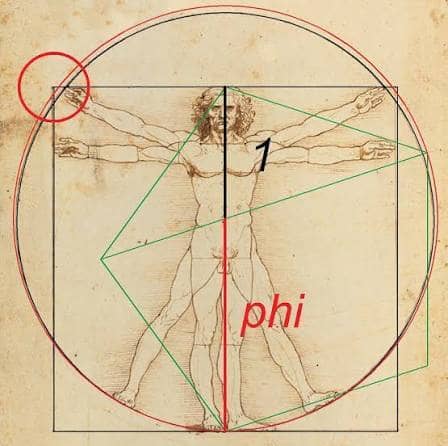
The Renaissance was a time when the exploration of geometry and proportion was at its peak, and the Golden Ratio was seen as a key to unlocking the secrets of nature and art.Leonardo’s “The Last Supper” is said to be composed according to the Golden Ratio, with key elements of the painting positioned at points that divide the canvas into sections of this divine proportion. Michelangelo’s “David” also exhibits proportions that align with the Golden Ratio, contributing to the statue’s sense of balance and perfection.
The Mathematics Behind the Golden Ratio
At the heart of the Golden Ratio is a simple, yet profound mathematical relationship. It can be derived through algebra, geometry, and even the Fibonacci sequence.
What is the Golden Ratio?
The golden ratio, also known as the golden number, golden proportion, or the divine proportion, is a ratio between two numbers that equals approximately 1.618. Usually written as the Greek letter phi, it is strongly associated with the Fibonacci sequence, a series of numbers wherein each number is added to the last. The Golden Ratio, denoted by the Greek letter Phi (Φ), approximately equals 1.6180339887. It is derived from the relationship between two quantities where the ratio of the larger quantity to the smaller quantity is the same as the ratio of their sum to the larger quantity. Mathematically, this can be expressed as:
a+ba=ab=Φ\frac{a + b}{a} = \frac{a}{b} = \Phiaa+b=ba=Φ
This equation describes a proportion where the sum of two quantities relates to the larger quantity in the same way that the larger quantity relates to the smaller one. The result is a number that, while irrational (meaning it has an infinite number of decimals without repeating), encapsulates a harmonious balance that can be observed in various forms of nature and human creation.

What is The Fibonacci Sequence?
The Fibonacci sequence is another fascinating connection to the Golden Ratio. The Golden Ratio, or Phi, = 1.61803398875…(an irrational number with an infinite number of digits) is also called the Divine Proportion.
Without getting too much into the math behind the Golden Ratio, what you need to know that when you divide a line in a special way, when the ratio of the large piece to the small piece is exactly the same as the ratio of the whole line to the large piece, this point is the Golden Ratio of both is 1.618 to 1, or Phi.
The sequence starts with 0 and 1, and each subsequent number is the sum of the two preceding ones: 0, 1, 1, 2, 3, 5, 8, 13, 21, 34, and so on. As the sequence progresses, the ratio of consecutive Fibonacci numbers converges to the Golden Ratio. For example, 21/13 ≈ 1.615, and 34/21 ≈ 1.618. It is an Irrational Number (meaning we cannot write it as a simple fraction), but more than that … it is as far as we can get from being near any fraction.

This convergence illustrates the close relationship between the Fibonacci sequence and the Golden Ratio, a connection that appears frequently in natural patterns.
Geometric Representation of Golden Ratio
Geometrically, the Golden Ratio can be visualized in a simple rectangle. If a rectangle’s sides are in the Golden Ratio, and you remove a square from the rectangle, the remaining rectangle will also have the same proportions as the original. This self-similarity property is a hallmark of the Golden Ratio, making it a key concept in fractal geometry.
The Golden Ratio in Art and Architecture
Throughout history, the Golden Ratio has been employed by artists and architects to create aesthetically pleasing compositions. This divine proportion is believed to evoke a sense of harmony and balance that resonates with viewers.

Ancient Architecture
The Parthenon in Athens is one of the most famous examples of the Golden Ratio in architecture. The proportions of the Parthenon’s facade, as well as its overall structure, are believed to be based on the Golden Ratio. This proportion was thought to create a sense of order and beauty, reflecting the Greek pursuit of perfection in art and architecture.
Modern Art and Design
The Golden Ratio continues to influence modern art and design. The Swiss-French architect Le Corbusier developed a system of proportions based on the Golden Ratio, known as the Modulor. This system was intended to create harmony in architecture by relating the proportions of buildings to the human body. In graphic design, the Golden Ratio is often used to create layouts that are visually appealing and balanced, with proportions that feel natural to the human eye.
The Golden Ratio in Popular Culture
The Golden Ratio has permeated popular culture, appearing in literature, film, and even marketing. Dan Brown’s novel “The Da Vinci Code” popularized the concept, linking it to ancient mysteries and secret societies. The Golden Ratio has also been used in branding and logo design, with companies like Apple and Twitter employing it to create iconic logos that are both simple and visually appealing.

In film, directors and cinematographers sometimes use the Golden Ratio to compose shots that are pleasing to the eye. The Rule of Thirds, a common guideline in photography and cinematography, is a simplified version of the Golden Ratio, dividing an image into nine equal parts to create a balanced composition.
The Golden Ratio in Nature
The Golden Ratio is often described as nature’s perfect proportion, and for good reason. This ratio appears in various natural forms, from the spirals of shells to the branching of trees, and even in the proportions of the human body.
Spirals and Shells
One of the most famous natural occurrences of the Golden Ratio is in the spiral patterns found in shells, particularly the nautilus shell. The spiral follows the Golden Ratio, growing larger but maintaining the same shape as it expands. This spiral pattern is not limited to shells; it can also be seen in hurricanes, galaxies, and even the arrangement of seeds in a sunflower.

Plant Growth and Phyllotaxis
The arrangement of leaves, seeds, and petals in plants, known as phyllotaxis, often follows the Golden Ratio. For example, in many plants, the number of petals on a flower or the arrangement of leaves around a stem often corresponds to Fibonacci numbers. This arrangement allows for optimal exposure to sunlight and efficient packing, demonstrating how the Golden Ratio contributes to the efficiency of natural systems.
Human Anatomy
The Golden Ratio is also present in the human body. The proportions of various body parts, such as the length of the forearm to the hand or the distance from the navel to the floor compared to the height of a person, often approximate the Golden Ratio. This observation has led some to suggest that the Golden Ratio is linked to human perceptions of beauty, as it represents a harmonious and balanced proportion.
In 1855, the German researcher and professor Adolf Zeising, known for his studies of the Golden Ratio, published his work Aesthetic Researches (Ästhetische Forschungen). He measured approximately 2,000 human bodies and concluded that the Golden Ratio represents a universal principle of human proportions. According to his findings, the division of the human body at the navel is one of the most important indicators of the Golden Ratio.
The proportions of the male body average approximately 13:8 (1.625), which are slightly closer to the Golden Ratio than those of the female body, whose average proportion is about 8:5 (1.6).

In a newborn, the body proportion is approximately 1:1. By the age of 13, it reaches 1.6, and by the age of 21, it approaches the typical adult male proportion.
The Golden Ratio can also be observed in the proportions of other parts of the body, including the relationships between the upper arm, forearm, and hand, as well as between the hand and fingers, among many other anatomical measurements.
The Mystique of the Golden Ratio
The widespread occurrence of the Golden Ratio in nature, art, and architecture has led some researcher to view it as a mystical or divine proportion that represents an inherent order in the universe.
The golden ratio, seen in structures as vast as galaxies or as intricate as DNA, has long been the symbol of ideal harmony. Duke University’s Adrian Bejan ties this unique ratio to a universal law of nature’s design. Through his work on the constructal law, Bejan reveals how nature shapes itself to ease flow. The essence of the golden ratio, he suggests, lies in achieving maximal efficiency with minimal energy (Bejan, 2009)
This ratio allows structures to scale infinitely without changing their core shape, resulting in its recurrence throughout nature. By choosing the path of least resistance, the golden ratio epitomizes energy-efficient flow. This is evident in falcons, which harness the golden spiral for an energy-saving approach to their prey, and in plants, where Fibonacci spirals display energy optimization in phyllotaxis.
The Purpose of Life: Flow
The Constructal Law intertwines modern science with ancient spiritual writings, hinting at a unified purpose for all existence: to facilitate energy flow. Energy naturally seeks equilibrium, flowing from concentrations, like the sun, to the expansive universe.
Our individual purpose is deciphering our unique energy flow. Despite being made of the same elements, each person’s energy interplays differently. Our brains might share a similar number of nerves, but the connections, molded by experiences, are distinct, crafting our personalities.
The Enduring Legacy of the Golden Ratio
The Golden Ratio, with its blend of mathematical precision and natural beauty, continues to captivate minds across disciplines. Whether it’s the spirals of a sunflower, the layout of an ancient temple, or the proportions of a masterpiece, this divine proportion seems to hold the key to a universal language of harmony. While the mystique of the Golden Ratio may be exaggerated at times, its presence in the natural world and human creation is undeniable.
As we continue to explore the mysteries of the universe, the Golden Ratio serves as a reminder of the profound connections between mathematics, nature, and art. It is a symbol of the underlying order and beauty that pervades the world around us, a testament to the idea that there is indeed a divine proportion to life.