
The skin is often viewed simply as an outer covering—something that reflects beauty, age, or lifestyle. But in reality, it is a highly complex, multifunctional organ that works continuously to protect, regulate, and support the body. Every second, the skin is involved in countless processes that keep us alive and balanced, from shielding us against harmful environmental factors to maintaining internal stability.
Understanding the functions of the skin is essential not only for proper skincare but also for overall health awareness. When we know how the skin works, we can better recognize what it needs, how it responds to damage, and how to support its natural ability to repair and protect itself.
In this article, we will explore the main functions of the skin, how each layer contributes to its performance, and what happens when its protective barrier is compromised.
One of the primary properties of human skin is its ability to protect the body from mechanical, physical, and thermal injuries, as well as from pathogenic microorganisms and toxins. The skin performs the following functions:
- temperature regulation
- touch and sensation;
- synthesis of vitamin D;
- excretory function (participation in water-salt balance);
- protection from ultraviolet radiation;
- immune function;
- regulation of water balance;
- blood storage (about 1 liter of blood is contained in the superficial vascular networks of the dermis);
- respiratory function (absorption of oxygen and release of carbon dioxide).
The skin’s primary function is protective. It acts as a reliable barrier between the body and the external environment, providing continuous protection and maintaining homeostasis. This organ absorbs ultraviolet radiation and takes the primary impact from mechanical, chemical, and thermal damage. The skin can also act as a temporary reservoir for water and fats. In addition, waste products and toxins (such as ammonia and certain medications) can be excreted through the skin.
The skin is essential for overall health and well-being. Healthy skin forms a strong barrier between the external environment and the body’s internal systems. It provides protection against:
Ultraviolet radiation, cold, heat, moisture loss, and radiation exposure
The outermost layer of the skin—the stratum corneum—plays a key role in protecting the body from environmental factors and limiting trans epidermal water loss.
It contains components of the natural moisturizing factor (NMF), formed from substances present on the skin’s surface, including lactic acid and urea. These components help retain water and keep the skin elastic, firm, and soft. When these substances are lacking, the skin loses moisture. If the hydration level of the stratum corneum drops below 8–10%, the skin becomes rough, dry, and prone to cracking.
When the skin is continuously exposed to ultraviolet radiation, melanin production increases in the basal layer of the epidermis. The skin may thicken, and hyperpigmentation can develop.
Mechanical damage
The epidermis serves as the first line of defense. Fat cells in the hypodermis absorb shock, protecting muscle tissue and fascia (the connective tissue surrounding muscles).
When the skin is subjected to repeated mechanical stress, the stratum corneum thickens. For example, constant friction on the hands or feet can lead to the formation of calluses.
Chemical substances
The buffering capacity of the hydrolipid film and the protective acid mantle helps shield the body from harmful alkaline chemicals.
Thermoregulation
The skin acts as a “thermostat” for the body, regulating temperature through the constriction and dilation of blood vessels, as well as through sweating. Fat tissue in the hypodermis helps retain heat.
Bacteria and viruses
The stratum corneum and its protective acid mantle prevent the penetration of bacteria and fungi. If harmful microorganisms bypass this first line of defense, the skin’s immune system becomes activated. The skin is a unique multifunctional organ involved in many vital processes in the body.
Touch and sensation: nerve endings in the skin allow us to perceive pressure, vibration, touch, pain, heat, and cold.
Regeneration: the skin has the ability to repair itself and heal damage.
Nutrient storage: fat cells in the hypodermis serve as an important reservoir of nutrients. When the body needs energy, these reserves are released into the bloodstream to support organs that require nourishment. Fat cells in the hypodermis also contribute to protecting the body from both cold and heat.
The skin also serves as a reservoir—it contains water and fat that can be used as energy sources. Approximately 10% of the body’s blood is contained within the skin’s vascular system.
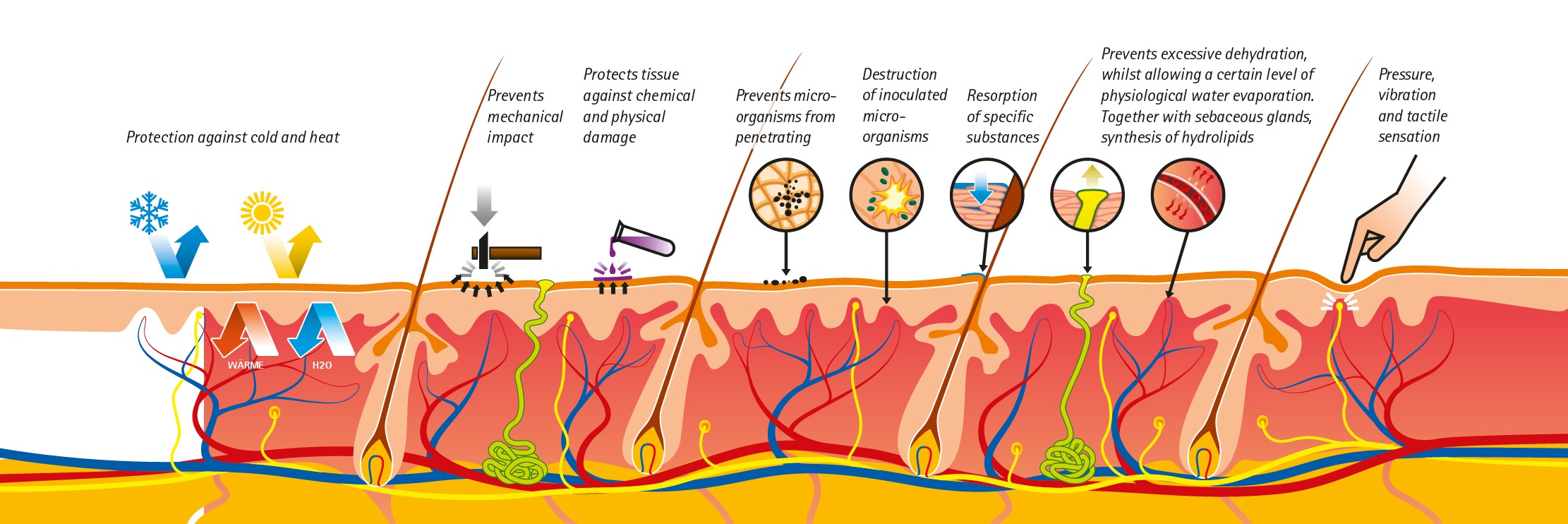
The skin participates in metabolism by absorbing ultraviolet radiation and synthesizing vitamin D. It also performs an excretory function, helping remove excess water, mineral salts, and toxins through sweat.
The skin plays an important psychological and aesthetic role, as it is the most visible indicator of health. Its color and condition significantly influence a person’s appearance, self-esteem, and how they are perceived by others. Healthy, clear skin contributes to a sense of inner comfort and confidence.
Functions of the Epidermis
As the outermost layer of the skin, the epidermis performs the greatest number of functions. Its main roles include:
- Protection: the epidermis acts as the body’s outer shield, preventing the penetration of harmful substances, microorganisms, and ultraviolet radiation. It also prevents moisture loss and maintains internal balance (homeostasis).
- Temperature regulation: through sweat glands, the skin releases sweat, which evaporates and cools the body in hot conditions. In cold environments, blood vessels constrict to preserve heat.
- Vitamin D synthesis: under ultraviolet exposure, the epidermis produces precursors of vitamin D, which plays an essential role in calcium metabolism and bone health.
- Sensation: the skin contains numerous nerve endings that allow us to perceive tactile stimuli such as touch, pressure, pain, and temperature changes.
- Regeneration and renewal: the epidermis constantly renews itself through the basal layer, which generates new cells to replace those that are shed.
- Immune defense: Langerhans cells in the epidermis are part of the immune system and help fight microbes and infections.
- Recognition and protection from harmful substances: receptors in the epidermis help detect and respond to potentially dangerous substances on the skin’s surface, such as chemical irritants and toxins.
- Melanin production and storage: melanocytes in the epidermis produce melanin, which determines skin color and protects against ultraviolet radiation.
- Water retention: the epidermis forms a barrier that prevents moisture loss and maintains skin hydration.

The epidermis can also perform metabolic functions, such as lipid synthesis. It plays an active role in inflammatory responses and wound healing by generating new cells and regulating immune reactions.
Functions of the Dermis
Blood vessels in the dermis supply oxygen and nutrients to the epidermis, supporting its regeneration and healthy function. They also regulate heat exchange, helping maintain optimal body temperature.
The dermis serves as a structural foundation for the epidermis, providing support and anchoring. Its additional functions include:
- Mechanical protection: the dermis provides strength and elasticity, allowing the skin to withstand physical stress and prevent damage.
- Secretion of sebaceous and sweat glands: sebaceous glands produce sebum, which lubricates and protects the skin, while sweat glands release sweat to help cool the body.
- Moisture retention: the dermis can hold water, acting as a reservoir that supports hydration and elasticity.
- Synthesis of collagen and elastin: this layer produces proteins that give the skin strength, firmness, and flexibility.
- Waste removal: blood vessels help eliminate toxins, contributing to skin health and clarity.
Like the epidermis, the dermis also performs sensory and protective functions. It contains immune cells (such as lymphocytes and macrophages) that detect and destroy pathogens and participate in wound healing. The dermis also produces signaling molecules (cytokines) that regulate immune responses, helping protect the body from infections.
Functions of the Hypodermis
The hypodermis plays a crucial role in maintaining body temperature. Fat cells contain a high concentration of mitochondria that oxidize fats and generate heat, increasing thermogenesis (the body’s heat production process). It also acts as insulation, helping retain heat in cold conditions.
The hypodermis protects internal organs—such as the heart and kidneys—from injury and impact. Other functions include:
- Energy reserve: fat cells serve as the body’s primary energy source, breaking down into glycerol and fatty acids when needed.
- Structural support: the hypodermis supports the dermis and epidermis, providing stability and cushioning.
- Regulation of blood flow: it contains numerous blood vessels that deliver oxygen and nutrients to the skin and surrounding tissues.
- Water storage: fat cells can store significant amounts of water, helping maintain hydration.
- Shock absorption: it cushions impacts and reduces the risk of injury.
- Insulation and protection: it helps maintain a stable body temperature by protecting against both cold and heat.
- Participation in metabolism: the hypodermis is involved in lipid metabolism and hormone production, playing a role in glucose regulation and overall metabolic balance.
- Vitamin storage: fat cells can store certain vitamins, which are later used by the body.
The hypodermis also contributes to body shape and contour. Fat cells fill the spaces between organs, muscles, and bones, creating natural volume and structure.
What Happens When the Skin Is Damaged?
Healthy, clean skin has an even tone and a smooth texture. It is well-hydrated and moderately sensitive to touch and temperature. When the natural barrier is damaged, the skin’s protective function is disrupted, and its appearance changes:
- The skin loses moisture and elasticity, becoming dry, rough, and prone to cracking and/or sagging.
- The skin becomes overly sensitive to external factors (such as sunlight and temperature changes) and more vulnerable to infections.
Infected skin may become inflamed. This occurs when immune cells attempt to restore the damaged barrier and eliminate invading microorganisms.
The skin has several mechanisms for regeneration and healing. The basal layer, whose cells are constantly dividing, ensures the gradual renewal of the epidermis:
- If only the superficial layer of the skin is affected, such damage (erosion) can heal without leaving a scar
- If the damage reaches the dermis and the basement membrane (for example, in the case of an ulcer), healing will result in scar formation.
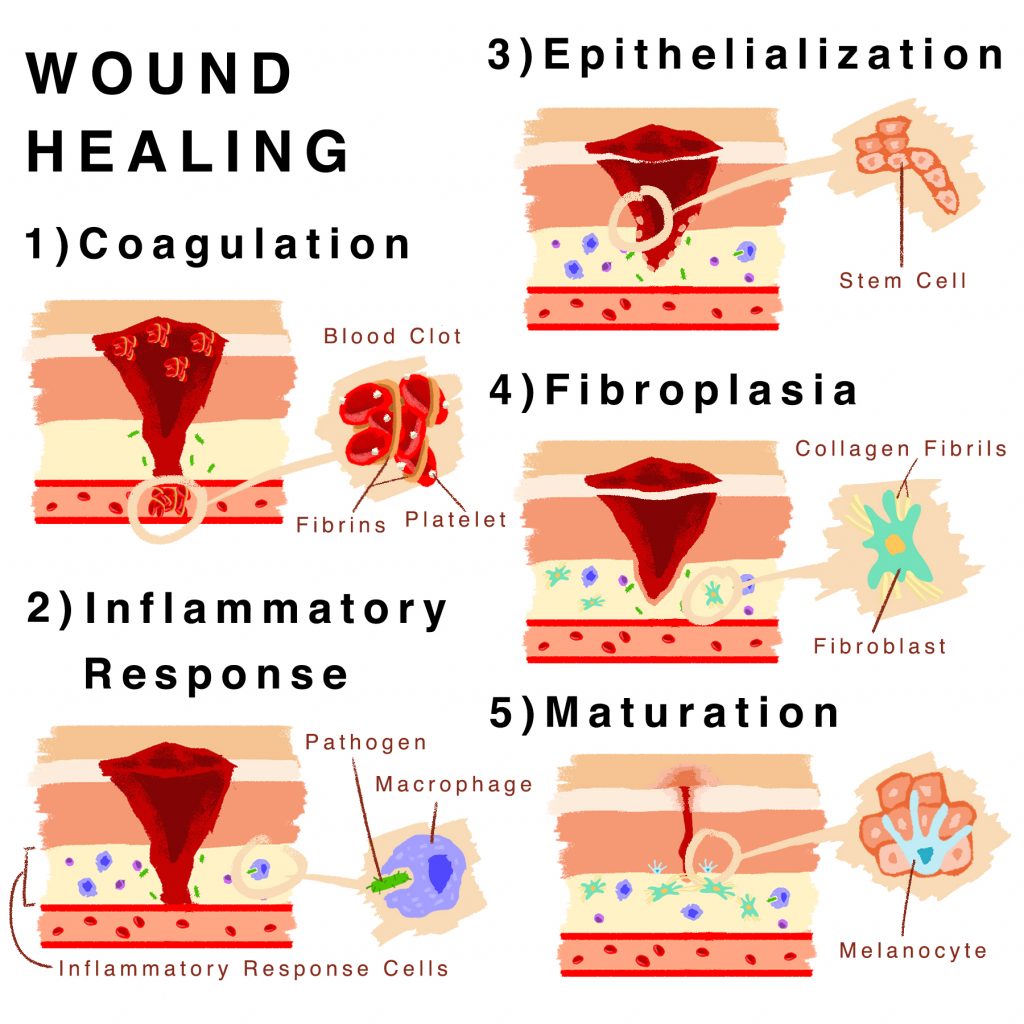
Wound healing occurs through several sequential stages:
- Clotted blood forms a protective crust (scab) that closes the wound.
- Dead and damaged cells, along with their connective tissue, are broken down by enzymes.
- Cells that absorb harmful bacteria and dead tissue become active, and lymphatic fluid fills the wound.
- Epithelialization occurs: new cells form, including capillary sprouts, connective tissue, and collagen fibers.
The skin is far more than just a protective covering—it is a dynamic, intelligent system that supports nearly every aspect of our health. From regulating temperature and sensing the world around us to protecting against external threats and aiding in recovery, the skin performs an extraordinary range of functions every day.
Each layer—the epidermis, dermis, and hypodermis—plays a unique role, yet they all work together seamlessly to maintain balance and resilience. When the skin is healthy, these processes function efficiently, allowing it to protect, renew, and adapt. However, when the skin barrier is damaged, even small disruptions can affect its ability to perform these essential roles.
By understanding how the skin works and what happens when it is compromised, we can approach skincare with greater awareness and intention. Supporting the skin’s natural functions through proper care, protection, and lifestyle choices helps maintain not only its appearance but also its long-term health and vitality.